

Solar energy employed 7.2 million people worldwide in 2024 - 44% of all renewable energy jobs. Almost all of them work on one technology - converting sunlight into electricity through photovoltaic cells, or less commonly through concentrated thermal systems - and almost all of that work follows new capacity. The world added a record 597 GW of new capacity that year, more than the entire installed base in existence a decade ago. China holds 58% of the workforce; the EU holds about 11%; the gap between the two is where the interesting labour-market story sits.
That story is two crises happening in parallel. On the manufacturing side, the four largest Chinese module makers booked USD 1.54 billion in combined losses in H1 2025 as wafer-thin margins collapsed under their own production volume. On the installation side, Germany's renewables training body RENAC estimates a shortfall of 60,000 to 100,000 qualified workers, and Bundesagentur für Arbeit (the federal labour agency) data puts the average vacancy duration for solar electrical roles at 142 days. The headline employment number is one of the largest in the energy sector, but it conceals a workforce that is being hired aggressively in some segments and laid off in others.
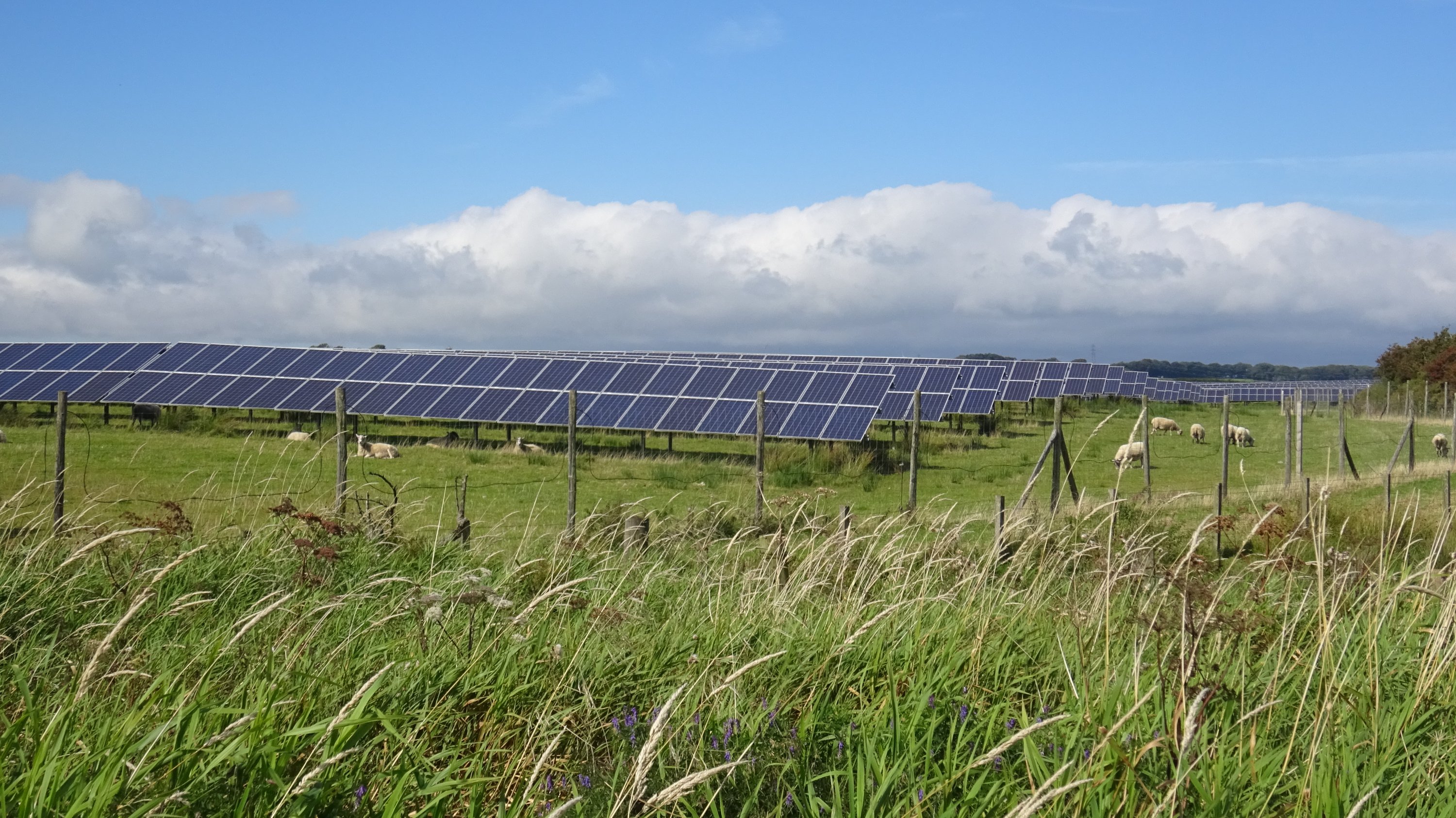
Ground-mounted solar PV array at Kilwinning Solar Farm in North Ayrshire, Scotland. Photo: Rosser1954, CC BY-SA 4.0 / Wikimedia Commons
Oversupply and labour shortage
The oversupply problem is structural. Module prices fell to EUR 0.085-0.095 per watt in late 2024 and early 2025 - "one of the most intense oversupply cycles in history" in Wood Mackenzie's phrasing. Chinese authorities have responded by cutting factory utilisation rates by as much as 70%, withdrawing the 13% VAT export rebate on solar products, and targeting PERC capacity for retirement. Polysilicon prices surged roughly 50% in September 2025, but the damage was already done. JinkoSolar, LONGi, JA Solar, and Trina Solar shipped close to 150 GW between them in H1 2025, and all four reported losses. IRENA recorded the first slowdown in renewable jobs since the agency began tracking the metric, with Chinese solar headcount falling from 4.59 million in 2023 to 4.2 million in 2024. The losses sit in module assembly and auxiliary materials. R&D and high-efficiency cell lines are still hiring.
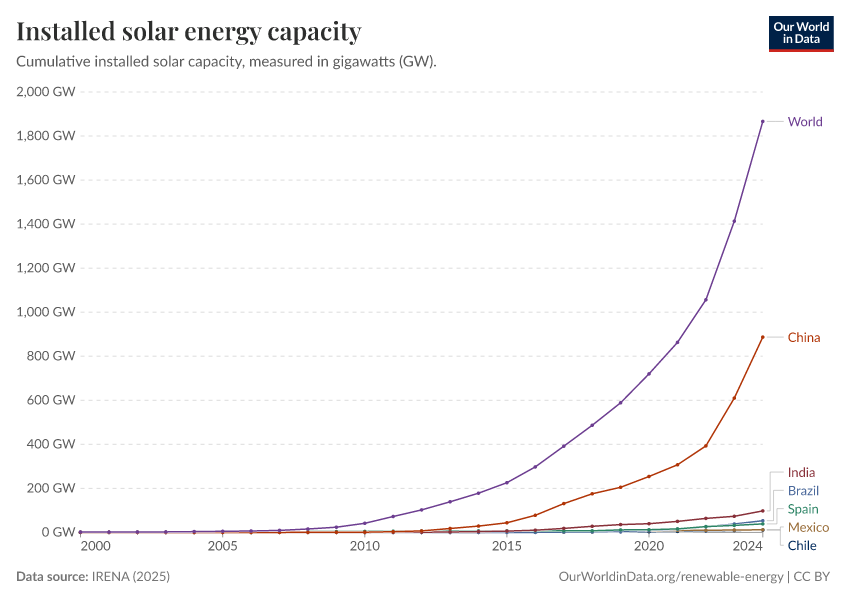
Global installed solar PV capacity, year by year. Source: Our World in Data, CC BY 4.0
Europe's problem is the opposite. Module supply is abundant and cheap, but the workforce to install the panels is missing. The German PV electrician shortage runs to roughly 60,000 to 100,000 people on RENAC's late-2024 estimate; 74% of installation firms surveyed by BSW Solar in 2025 reported difficulty filling technical roles. The three-year Elektroniker für Energie- und Gebäudetechnik Ausbildung is structurally too slow to close the gap before 2028 even if intake doubled tomorrow. Vacancy duration is 142 days. Wages in the solar installation trades are rising faster than in adjacent construction work as a result.
Europe
EU solar employment reached a record 865,000 in 2024 and is projected to lose roughly 5% in 2025 before recovering to 916,000 by 2029. The shape of that recovery is what matters for job seekers. Rooftop's share of the EU workforce has fallen from 73% in 2022 to 59% in 2024, with SolarPower Europe projecting 56% by 2029. The next decade of hiring sits disproportionately in utility-scale solar, solar O&M, and grid integration, not residential rooftop.
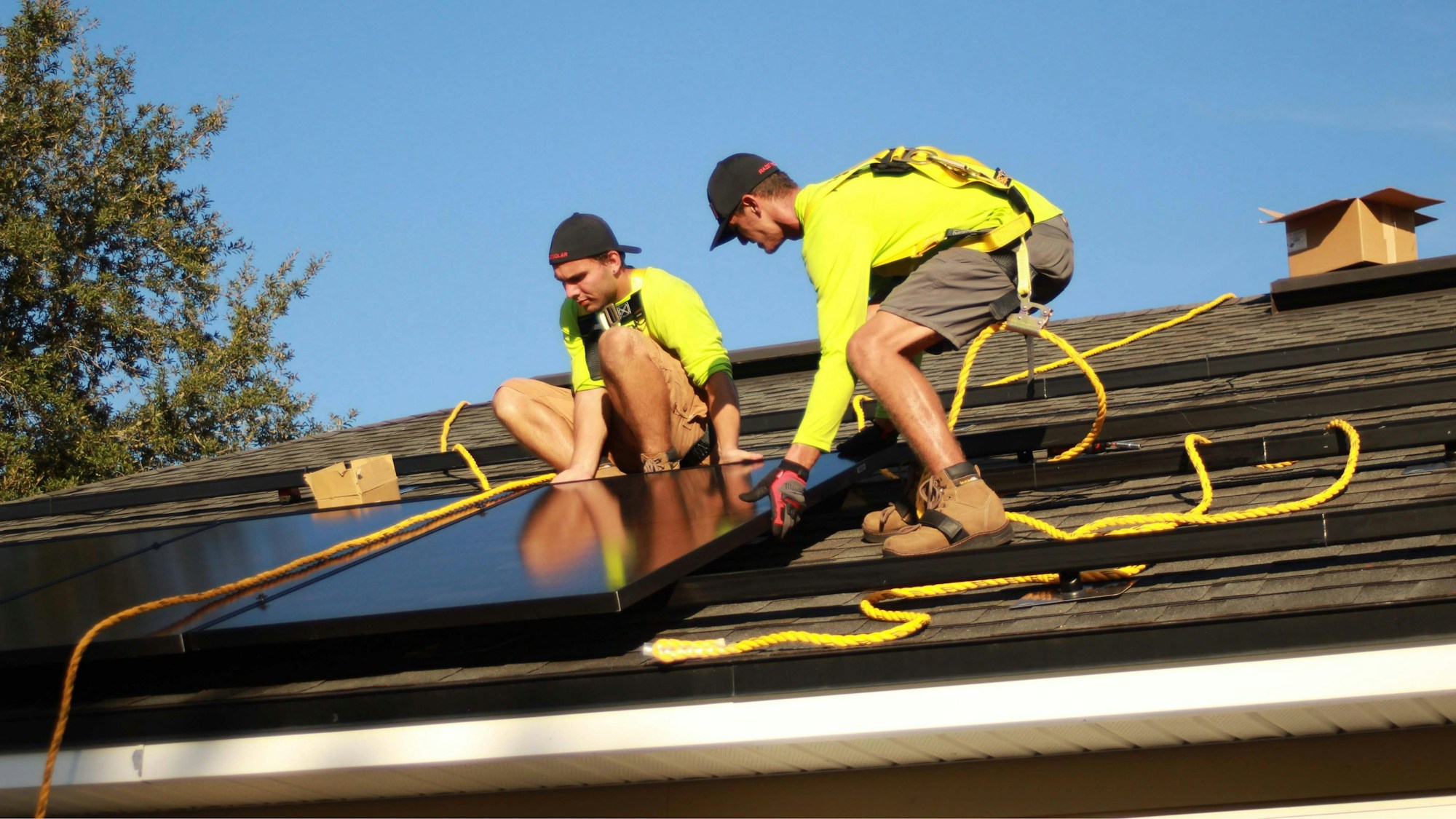
Workers performing a rooftop solar PV installation, the largest single solar-jobs segment. Photo: Raze Solar, Unsplash License / Unsplash
Germany remains the largest EU employer at 128,000 jobs - despite a 17% workforce contraction between 2023 and 2024 as the residential market cooled. Spain is the structural winner: 122,000 jobs, heavy weighting toward utility-scale, and projections that put it on a path to overtake Germany within the next deployment cycle. Italy is growing fastest among the top employers, closing the gap with Spain on the back of disciplined utility-scale buildout and building-integrated PV (BIPV) mandates. Poland and France round out the top tier by headcount. The Netherlands is smaller by employment but dense in installed capacity - roughly 29 GW at end of 2024, increasingly concentrated in commercial rooftop and emerging floating solar. The UK sits outside the EU stats but is hiring at pace, with commercial rooftop and ground-mounted utility projects driving most of the field-engineering demand on warehouses, schools, supermarkets, and farmland.
China
China is not one figure in a global pie chart; it is the global pie. The country's 4.2 million solar workers in 2024 - down from 4.59 million in 2023 as the oversupply correction bit - still represent 58% of the world's solar workforce, and the country accounted for more than half of the 597 GW deployed globally in 2024. The headcount split matters: manufacturing employment is heavily concentrated in a handful of provinces, while installation work is distributed across nearly every prefecture. Polysilicon and ingot production sits in Xinjiang (where energy costs are lowest), Inner Mongolia, Sichuan, and Yunnan; module assembly is concentrated downstream in Jiangsu, Anhui, and Zhejiang. The four largest shippers - LONGi Green Energy (roughly 38,000 employees and one of the world's two largest module makers), JinkoSolar (41.8 GW shipped in H1 2025, multi-GW assembly capacity in Vietnam and Malaysia), JA Solar, and Trina Solar (32 GW in H1 2025, the licensee of Oxford PV's perovskite tandem technology since 2025) - sit at the centre of that geography. Behind them, Tongwei, the world's largest polysilicon and cell producer, and Canadian Solar round out the top tier.
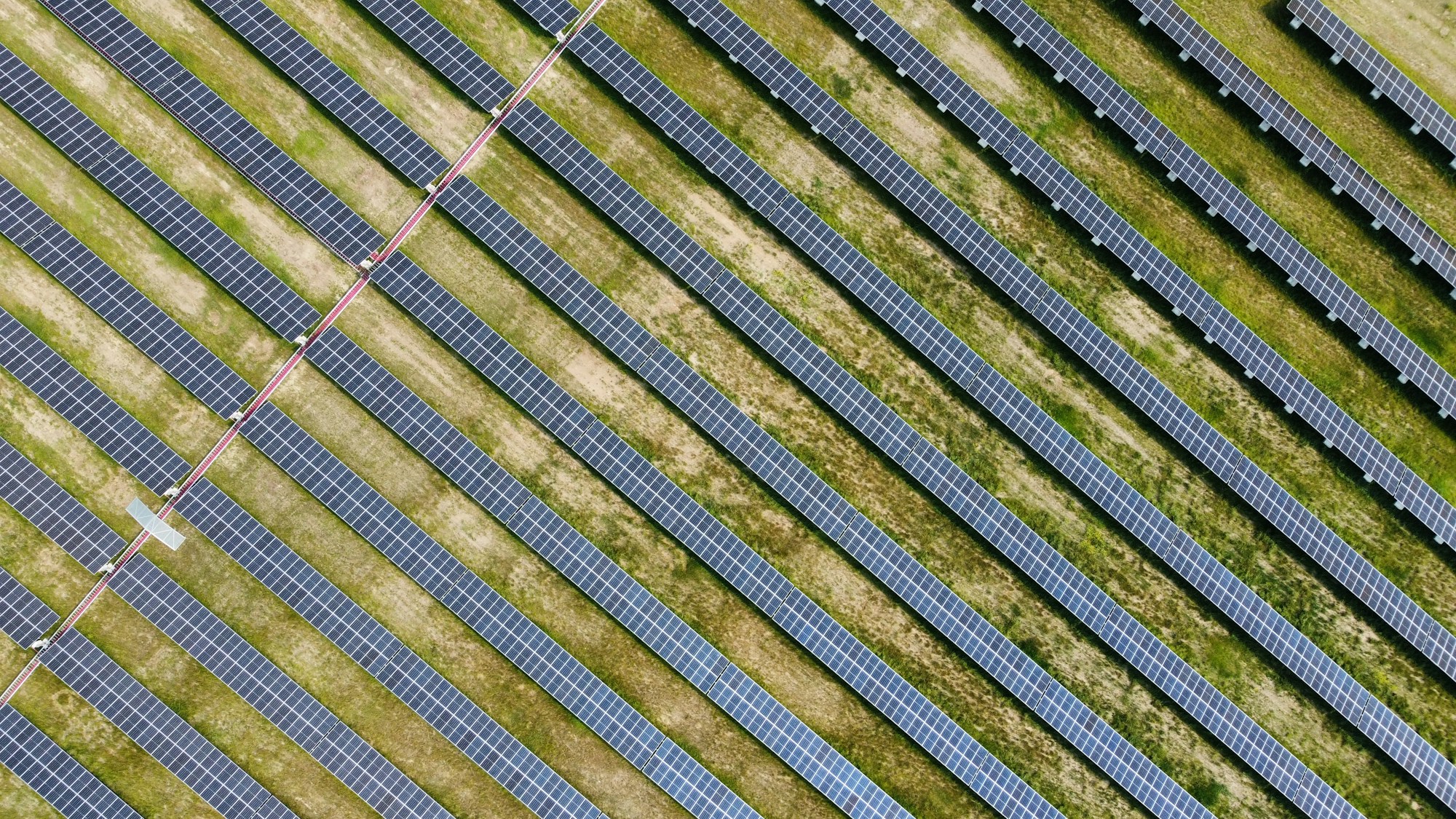
Aerial view of a large-scale solar farm, the dominant utility-scale solar built form. Photo: Daniel Miksha, Unsplash License / Unsplash
The hiring story inside China is the PERC-to-TOPCon retraining wave. Chinese authorities retired tens of gigawatts of PERC capacity in 2024-25, and the four big shippers have been redeploying or laying off the process engineers, equipment operators, and metallurgical staff who built their careers on PERC lines. R&D headcount in n-type cell development, perovskite-silicon tandem fabrication, and high-purity polysilicon process control is growing simultaneously. For European candidates the relevance is direct. Chinese OEMs are hiring abroad for European, MENA, and Latin American projects - LONGi, JinkoSolar, Trina, and JA all operate European sales, technical support, and project-execution offices, typically in Germany, the Netherlands, and Spain. And any European module-line engineer or BIPV process specialist increasingly needs to understand Chinese supplier QC standards: the cell, ribbon, and encapsulant on their line almost certainly came from a Chinese plant.
United States
The US is the world's second-largest solar market by deployment and the highest-paying market for the engineering tier. The Solar Energy Industries Association puts US solar employment at roughly 280,000 jobs at the end of 2024, with the SEIA / Wood Mackenzie US Solar Market Insight 2025 recording a record 50 GW of new capacity added in 2024 and a further 43 GW installed in 2025. The Inflation Reduction Act's Section 48E investment tax credit and 45Y production tax credit remain the core subsidy engines, but the One Big Beautiful Bill Act of 2025 sharply accelerated the phase-out for solar: projects must start construction by July 2026 and be in service by the end of 2027 to qualify, and domestic-content rules have tightened. Deployment is concentrated in three states: Texas (utility-scale buildout in the west of ERCOT, hybridised increasingly with battery storage), California (CAISO's solar-plus-storage fleet now routinely delivers more than 8 GW into the evening peak), and Arizona (utility-scale and the growing data-centre offtake market).
The employer base is a mix of installers, developers, and a reshoring manufacturing wave. First Solar (FSLR) is the dominant US-headquartered module manufacturer and has roughly 8,000 employees globally; the company's Ohio, Alabama, and Louisiana plants are scaling toward 14 GW of US nameplate capacity by end-2026 under the IRA's 45X advanced-manufacturing credit. Nextracker, the global single-axis tracker leader, is headquartered in California and has expanded its US steel-and-fabrication supplier base sharply since 2023. On the deployment side, Sunrun and Sunnova lead residential leasing despite a turbulent 2024-25 (Sunnova entered Chapter 11 in mid-2025 and is restructuring); SunPower restructured separately. Utility-scale construction is dominated by EPCs including Mortenson, Blattner, and Primoris. For European candidates the pull is salary: US BESS (battery energy storage) and solar-plus-storage commissioning engineers, dispatch traders, and senior project developers typically earn around 30% above European equivalents at the senior level - which is why FREYR and several European EPCs have moved staff to Texas and California since 2023, and a steady trickle of individuals have made the move on their own.
India
India is the fastest-growing major solar market and now employs approximately 384,900 workers according to IRENA, up roughly 17% on 2023. The country added 24.5 GW in 2024 and is targeting 500 GW of non-fossil capacity by 2030, of which solar carries the largest share. The hiring centre of gravity is shifting from EPC and rooftop installation toward domestic module and cell manufacturing under the Production-Linked Incentive (PLI) scheme, which has channelled subsidy support into integrated polysilicon-to-module capacity. Adani Solar, Waaree Energies, Tata Power Solar, ReNew Power, and Vikram Solar are the largest domestic players; Waaree's Gujarat module facility and Adani's Mundra integrated cell-and-module plant are the most visible recipients of PLI capital. Module manufacturing capacity is projected to more than double between 2024 and 2027, with EPC contracting, O&M, and grid-integration roles growing alongside utility-scale auctions led by the Solar Energy Corporation of India (SECI).
Africa
No region is adding solar jobs faster in percentage terms than Africa: PV employment rose 23% in a year on IRENA's count. The continent's job market splits into three distinct geographies. South Africa runs the largest formal utility-scale and rooftop industry, driven by Eskom load-shedding and the REIPPPP auction programme - Scatec, Globeleq, Mainstream Renewable Power (majority-owned by Aker Horizons), and Engie operate most of the large IPP (independent power producer) portfolios. Egypt hosts the Benban solar park (1.8 GW across 32 plants in Aswan, the largest solar complex in Africa) and is now developing the 10 GW Suez Wind and complementary solar mega-pipeline. Across the Sahel and East Africa, off-grid and mini-grid deployment dominates: pay-as-you-go residential systems and village mini-grids run by Sun King, d.light, Engie Energy Access, and PowerGen Renewable Energy employ tens of thousands of field agents, technicians, and last-mile installers. The technical-skills gap is the binding constraint in every sub-region, and most utility-scale projects still depend on expatriate engineering management.
Cell technology and hiring impact
The cell technology mix is shifting faster than the industry's job postings reflect. PERC dominated module manufacturing for a decade and is being retired - both by Chinese policy and by basic physics. TOPCon overtook PERC during 2024, closing the year at roughly half of new module production, and is projected to hold 84% of the global cell market by 2029. TOPCon delivers around 26.1% cell efficiency and an 85% bifaciality factor (rear-face yield as a share of front) against PERC's 24.5% and 70%. Heterojunction (HJT) goes further still, at 26.56% efficiency and 92% bifaciality, but at a manufacturing cost premium that has kept it niche so far. Bifacial modules now account for the overwhelming majority of new utility-scale projects.
For hiring, this matters in three concrete ways. First, the engineers and process technicians who built their careers around PERC lines are being retrained or laid off - China's PERC retirements in 2024-25 ran to tens of gigawatts. Second, the n-type cell process is more sensitive to contamination and dopant control, so quality engineering, metallurgical chemistry, and process integration roles command a premium at TOPCon and HJT fabs. Third, perovskite solar cells - long the lab-bench technology of choice - crossed into commercial production in late 2024 when Oxford PV shipped its first 72-cell tandem modules at 24.5% module efficiency to a US customer. Oxford PV's licensing deal with Trina Solar in 2025 is the inflection point: perovskite-silicon tandems are now a hiring category in their own right, with the company targeting 26% modules in 2026.
Roles along the value chain
Installation and construction
The largest job category and the easiest entry point.
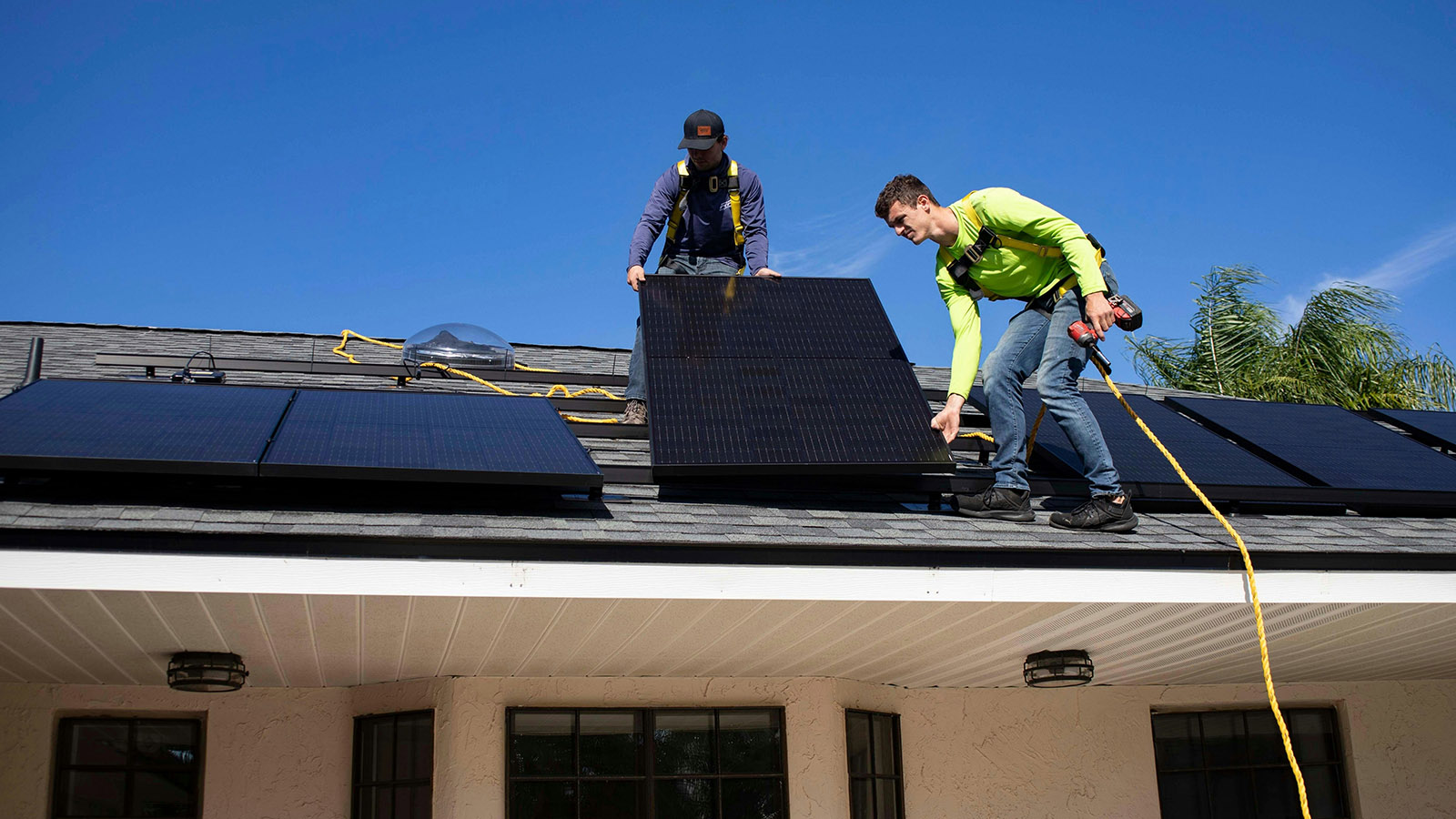
Solar PV installers mount panels, run DC and AC cabling, terminate inverters, and commission systems. The work is physical and outdoors - rooftops, scaffolds, ballasted ground arrays. In the EU, installers earn EUR 40,000 to EUR 55,000 annually depending on country, with Germany toward the top.
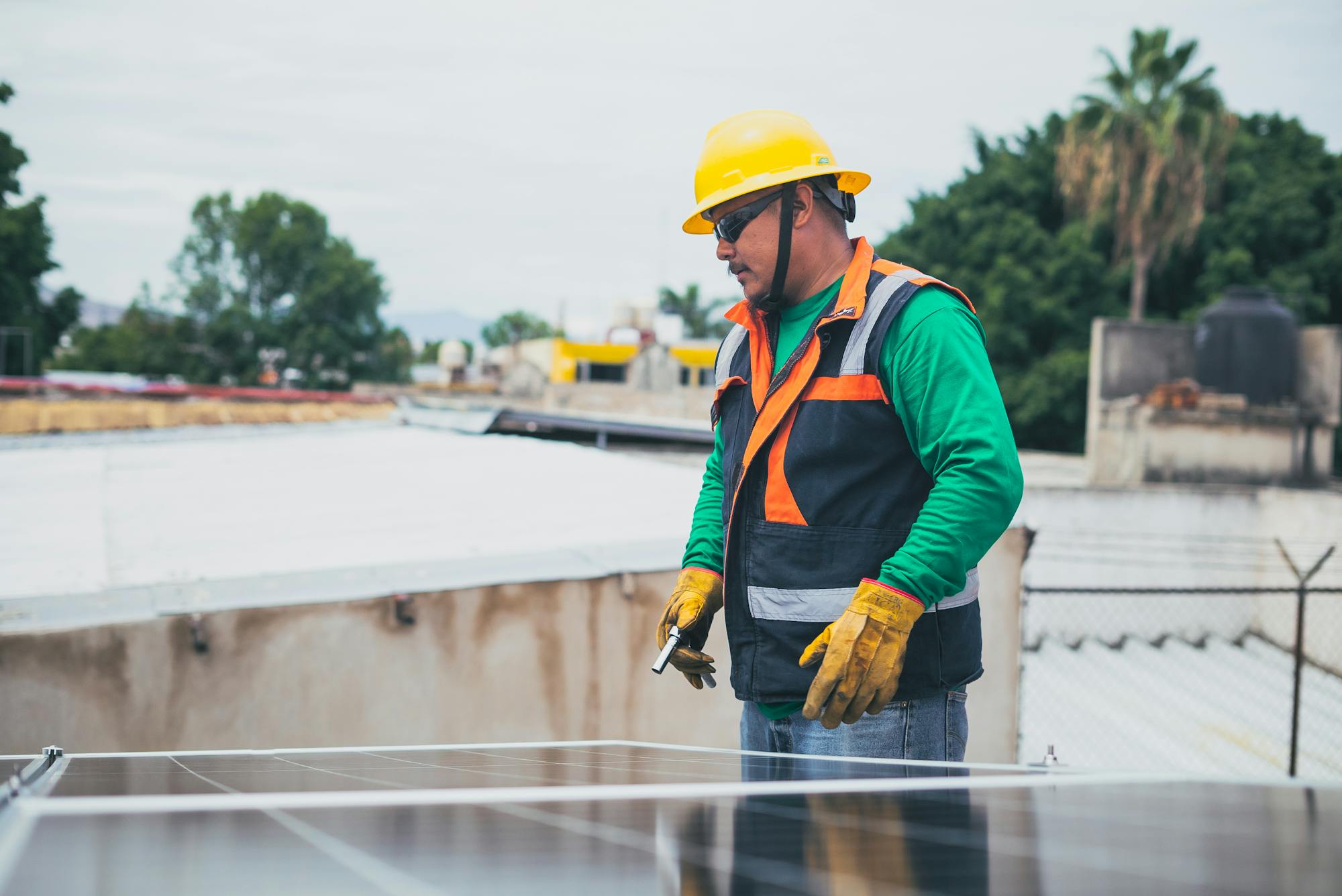
Solar technician inspecting a rooftop PV array. Photo: Kindel Media, Pexels License / Pexels
Solar electricians handle the DC side, inverter integration, and grid interconnection. This is the role German BSW data flags as the hardest to fill - a qualified Elektroniker für Energie- und Gebäudetechnik with PV competence is the bottleneck in most northern European markets.
Site supervisors and crew leaders coordinate residential and commercial installations, manage safety compliance, and run quality checks against EPC specifications. The role often emerges from three to five years of field experience rather than a separate qualification track.
Engineering and design
Solar design engineers produce permit-ready system layouts using PVsyst, Helioscope, AutoCAD, and Aurora Solar. The role increasingly extends into yield modelling under high-penetration grid conditions - inverter clipping, curtailment risk (output the grid cannot absorb), and DC oversizing decisions that affect project bankability. Most positions are office-based with hybrid arrangements common.
Electrical engineers design the power electronics, medium-voltage collection systems, and substation interconnection for utility-scale plants. The hybridisation of solar with energy storage and the spread of hybrid power plants have made this one of the most actively recruited specialisations in the sector.
Civil engineers handle mounting structures, foundation design, and site preparation. Demand spikes wherever utility-scale ground-mount pipelines are active - Andalucía, Castilla-La Mancha, and Aragón in Spain, Puglia and the wider south in Italy, and the Iberian interior generally.
Project development and finance
Solar project developers identify sites, negotiate land leases and rooftop agreements, secure grid connections, run permitting, and arrange financing. In Spain in particular, where grid-connection capacity is a binding constraint, developers who can navigate the regional point-of-connection allocation process are valuable.
Project finance specialists structure debt, equity, and PPA terms. Recent years have made offtake pricing the dominant variable, with corporate PPAs replacing feed-in tariffs as the primary revenue mechanism in most mature European markets.
Operations and maintenance
Solar O&M technicians inspect panels, clean and rewire arrays, replace failed inverters, grease tracker drives, and chase down underperformance leads from SCADA data. As the installed base nears 3 TW and the inverters from the early 2010s reach end of warranty, solar O&M is one of the fastest-growing segments in the workforce - though the recurring nature of the work means headcount grows more slowly than installed capacity.
Performance analysts and asset managers monitor portfolios, model degradation curves, and decide when to repower or refinance. The growth of repowering as a discrete segment - replacing first-generation modules and inverters with current-generation kit on existing sites - has made portfolio engineering a senior-track role.
Manufacturing
European module manufacturing is much smaller than China's and under sustained price pressure, but firms aligned with the European Solar Manufacturing Council (ESMC) are hiring around the Solar Manufacturing Accelerator and the EU Net-Zero Industry Act. Roles cluster in process engineering, contamination control, glass and EVA handling, and stringer operation. Italy's BIPV manufacturing base in Veneto and Lombardia is one of the more active sub-segments.
Sub-segment specialisations
Agrivoltaics combines crop production with elevated PV. France is the largest agri-PV market in Europe under a strict agricultural-first regulatory framework that requires contractual links between developer and farmer; Germany's Solarpaket 1 ringfenced 800 MW for agrivoltaics in 2025 auctions and 1,200 MW in 2026; Italy is funding 1.04 GW by mid-2026 through a EUR 1.1 billion programme. The roles that did not exist five years ago - agronomist-integrated project developer, dual-use yield modeller, shade-tolerant crop specialist - now appear regularly in postings.
Building-integrated PV is growing fastest of all. The European BIPV market is projected at a 33.8% CAGR through 2030, driven by EU energy-efficiency directives. Italy alone is projected at a 39.4% CAGR. BIPV demands a hybrid skill set - architectural facade specification, certified glazing installation, and PV electrical work - that the existing trades pipeline does not produce.
Floating solar is concentrated in the Netherlands, which hosts most of mainland Europe's deployed capacity on irrigation reservoirs, gravel lakes, and inland water bodies. RWE and SolarDuck's 5 MW offshore pilot inside the OranjeWind wind farm (formerly Hollandse Kust West VII), due in the water during the farm's 2026-2028 offshore build, is planned as the first commercial-scale test of offshore floating PV. The role profile overlaps with marine engineering and tidal infrastructure.
Salary overview
| Role | Germany | Spain | Netherlands | UK |
|---|---|---|---|---|
| Solar PV installer | EUR 40,000 - 55,000 | EUR 24,000 - 38,000 | EUR 38,000 - 52,000 | GBP 26,000 - 40,000 |
| Solar electrician (Elektroniker EuG) | EUR 45,000 - 65,000 | EUR 28,000 - 45,000 | EUR 42,000 - 58,000 | GBP 32,000 - 50,000 |
| Solar design engineer | EUR 50,000 - 72,000 | EUR 35,000 - 55,000 | EUR 50,000 - 70,000 | GBP 38,000 - 58,000 |
| Electrical engineer (utility-scale) | EUR 55,000 - 85,000 | EUR 40,000 - 65,000 | EUR 55,000 - 80,000 | GBP 42,000 - 70,000 |
| Project manager | EUR 60,000 - 90,000 | EUR 42,000 - 72,000 | EUR 55,000 - 85,000 | GBP 45,000 - 75,000 |
| O&M technician | EUR 38,000 - 55,000 | EUR 28,000 - 42,000 | EUR 38,000 - 52,000 | GBP 30,000 - 45,000 |
| Asset manager | EUR 65,000 - 110,000 | EUR 48,000 - 85,000 | EUR 60,000 - 100,000 | GBP 50,000 - 95,000 |
Annual gross ranges from 2024-2025 data: SalaryExpert, Glassdoor, Astute People Renewable Energy Salary Guide 2025. UK renewables salaries rose 13.2% on average in 2025. Spanish ranges reflect a lower cost-of-living base and the dominance of utility-scale work outside Madrid and Barcelona. US comparators in ERCOT and CAISO typically run around 30% above the German figures for utility-scale engineering, project development and dispatch roles. Specialisation in storage-hybrid plant engineering or HJT/perovskite manufacturing adds 10-20%.
Qualifications and training
The vocational route varies sharply by country and is where the German skills shortage is most acute. The standard pathway in Germany is a three-year Ausbildung as Elektroniker für Energie- und Gebäudetechnik or Mechatroniker, with the BIBB updating the curriculum in 2025 to add a dedicated PV module. The Netherlands runs a comparable mbo-niveau 3 and 4 track. Denmark's Elektriker EUD route has integrated PV competence since 2021. Spain's FP Grado Superior tracks in Eficiencia Energética y Energía Solar Térmica and Sistemas Electrotécnicos y Automatizados are the standard pre-trade qualification. In the UK, a Level 3 electrotechnical qualification through the JIB or EAL plus the BPEC or NICEIC solar PV course unlocks MCS-certified installer work; certification under the Microgeneration Certification Scheme (MCS) is a practical requirement to install accreditation-eligible systems for the Smart Export Guarantee.
For office-track roles, the European baseline is a BSc or MSc in electrical, mechanical, or renewable energy engineering, with PVsyst and Helioscope proficiency now an expected line item rather than a differentiator. Project management certifications (PRINCE2, PMP) are valued in EPC contracting; the German Immissionsschutz (emissions-control) and Bauantrag (building-permit) regulatory framework rewards engineers who can sign off on grid-conformity studies.
The GWO Solar Safety Training Standard, launched in 2025 as an extension of the established wind-sector safety regime, is becoming the de facto standard for utility-scale installation crews. Over 190,000 people already hold GWO certificates from the wind sector, and the solar standard's structure makes cross-qualification straightforward.
Working conditions
Installation work is physical and the safety risks are real. Falls from height remain the leading cause of fatal injury, and the DC side of a PV system stays live in daylight regardless of any switch position - a DC arc fault can sustain itself at voltages well below where AC would extinguish - the hazard behind IEC 63027. Rigorous lockout-tagout (LOTO) procedures, PPE compliance, and the recent shift toward module-level rapid shutdown devices reduce the risk profile, but they do not eliminate it.
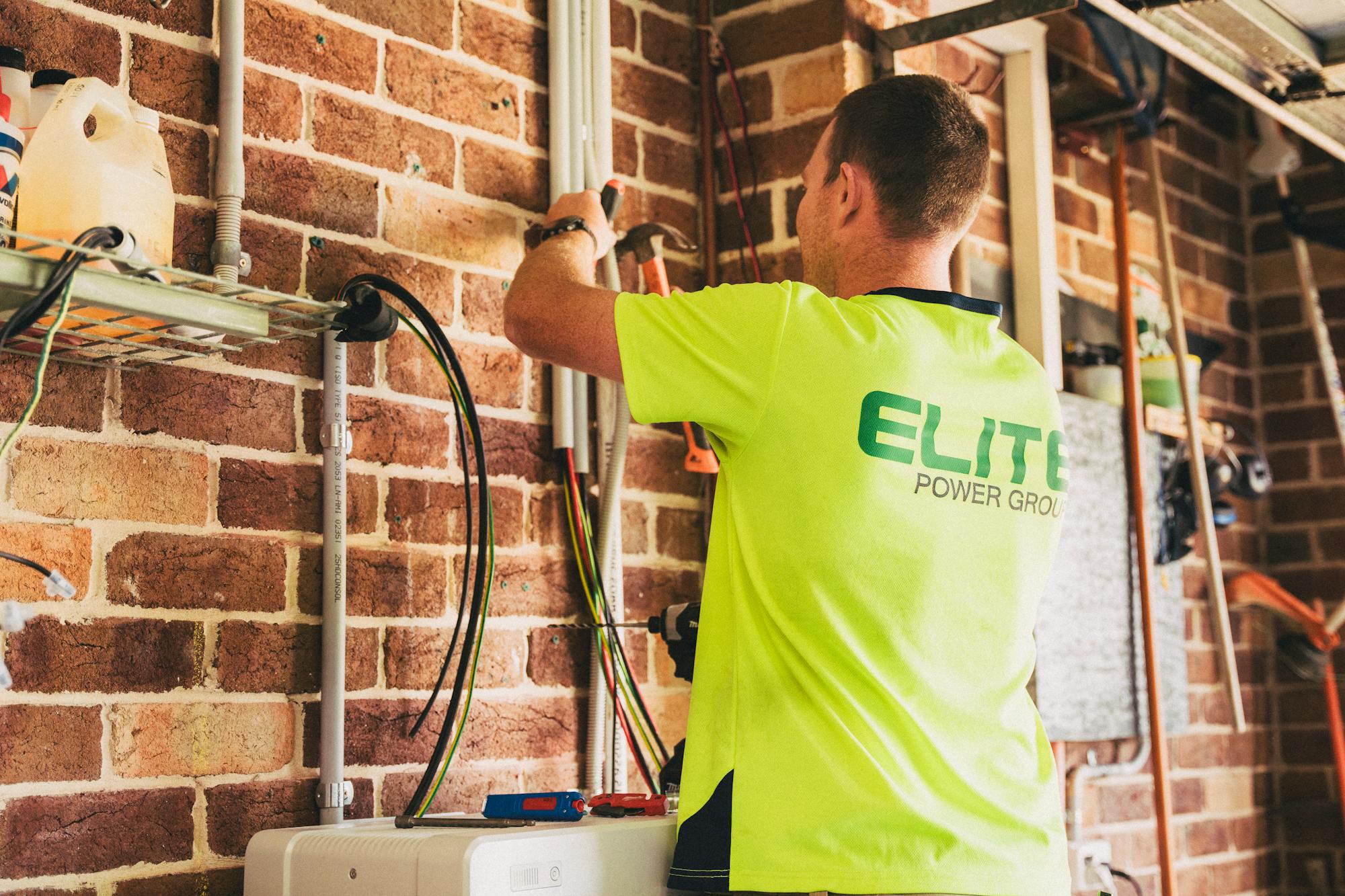
Electrician wiring a residential solar-coupled battery installation. Photo: Pexels, Pexels License
Seasonality affects northern installer markets - German and Dutch crews see project pipelines compress between November and February as new-build slows - but utility-scale construction in Spain, Portugal, and Italy runs essentially year-round outside the August shutdown. Office roles in design, project finance, asset management, and software run on standard hybrid arrangements, with remote work more available than in most adjacent trades.
The boom-bust history of the sector is worth understanding before committing. The Czech Republic's solar bubble of 2009-2010 - nearly 2 GW installed in two years under a feed-in tariff the government had not budgeted for - was followed by a retroactive solar tax and a near-decade freeze on PV deployment. Spain's pre-2008 solar boom followed a similar trajectory. The current European market is far better regulated and more disciplined, but the pattern of "subsidy generosity into political backlash into job losses" is a hazard the industry has not fully outgrown. China's 2024-25 oversupply correction is the most recent example.
The sector's diversity profile remains uneven. Women hold 32% of total renewables jobs according to IRENA, but representation in the electrical trades and on field crews is materially lower. Industry-funded initiatives have multiplied since 2022; measurable change in the field-crew demographic remains slow.
Transitioning from adjacent industries
Solar is the most accessible renewable energy sector for career changers, and the routes are well-trodden.
Construction and trades. Roofers, electricians, and general construction workers transfer with the shortest learning curve. The additional content is solar-specific electrical work, mounting-system competence, and DC safety. In Germany, Austria, Switzerland, and the Nordics, qualified Elektriker can add solar competence through short upskilling courses; in the UK, the BPEC solar PV course on top of a Level 3 electrotechnical qualification is the standard route.
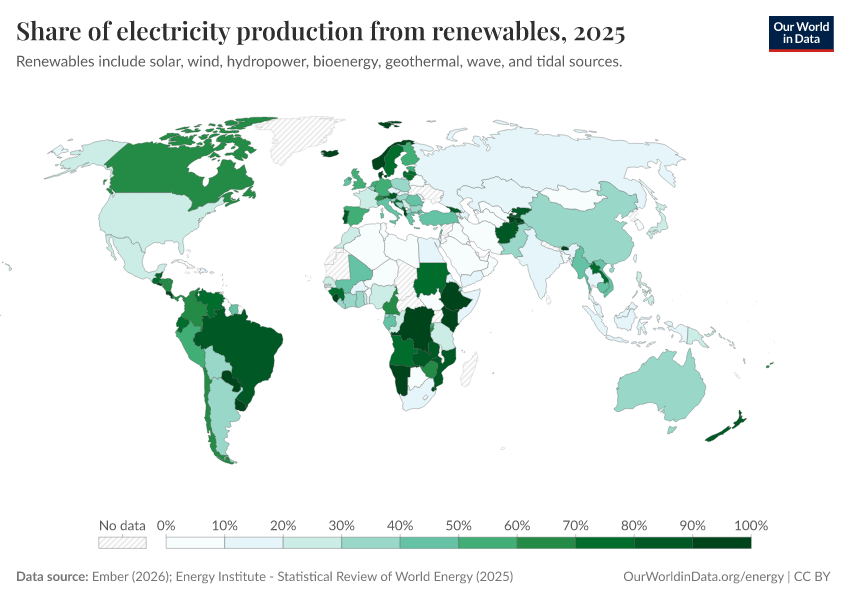
Share of electricity from renewables by country - the power-sector workforce that solar PV recruits from. Source: Our World in Data, CC BY 4.0
Oil and gas. Project management, site operations, HSE, and rotating-shift discipline translate directly. IRENA notes that roughly half of fossil-fuel workers facing redundancy this decade have skills demanded by clean energy; retraining often requires only weeks. The transition is most active in the UK North Sea cluster, the Netherlands' Groningen field workforce, and increasingly in Aberdeen-to-Andalucía mobility.
IT and software. The digitalisation of solar - design platforms, fleet monitoring, predictive maintenance, AI-augmented yield forecasting - creates demand for developers and data scientists. Prior energy-sector experience helps but is rarely required for software roles.
Manufacturing and industrial engineering. As European cell and module manufacturing rebuilds under the Net-Zero Industry Act, demand grows for engineers from automotive, semiconductor, and glass-industry backgrounds. The TOPCon-to-HJT transition is creating roles that did not exist three years ago.
Key employers
Module manufacturers
- LONGi Green Energy - China, one of the world's two largest module shippers and lead developer of perovskite-silicon tandems; roughly 38,000 employees
- JinkoSolar - China, 41.8 GW shipped in H1 2025; pioneer of the TOPCon transition; multi-GW manufacturing footprint in Vietnam and Malaysia
- Trina Solar - China, 32 GW shipped in H1 2025; licensee of Oxford PV's perovskite tandem technology since 2025
- JA Solar - China, global top-five module manufacturer with European headquarters in Munich
- Tongwei - China, world's largest polysilicon and solar cell producer; vertically integrated through wafer and module
- Canadian Solar - Canada/China, vertically integrated and active across utility-scale module supply in Europe
- First Solar - US, dominant US-headquartered manufacturer; CdTe thin-film technology; scaling toward 14 GW US nameplate capacity by end-2026
- Meyer Burger - Switzerland, HJT modules; German subsidiaries entered insolvency in May 2025, US HJT IP acquired by Swift Solar in 2026
- REC Group - Norway/Singapore, premium HJT modules, owned by Reliance Industries
- Oxford PV - UK, perovskite-silicon tandem manufacturing; first commercial tandem modules shipped September 2024
- Waaree Energies - India, largest Indian module manufacturer; PLI-backed Gujarat capacity expansion
- Adani Solar - India, integrated polysilicon-to-module operation at Mundra, Gujarat
Inverter and power electronics
- SMA Solar Technology - Germany, residential and utility-scale inverters; approximately 3,500 employees
- Sungrow - China, world's second-largest inverter manufacturer by shipments; rapidly expanded European footprint
- Huawei FusionSolar - China, leading string inverter brand globally
- Fronius International - Austria, residential and commercial inverters; family-owned
- Power Electronics - Spain, central inverters for utility-scale; Valencia HQ
- Enphase Energy - US, microinverter market leader; large European installation base
Trackers and balance of system
- Nextracker - US, global single-axis tracker market leader
- Soltec - Spain, European tracker leader headquartered in Murcia
- Array Technologies - US, single-axis trackers
- STI Norland - Spain, single and dual-axis trackers; acquired by Array
Utility-scale developers and EPCs
- Iberdrola - Spain, the largest European solar developer and asset owner
- EDP Renováveis - Portugal, global utility-scale solar pipeline with European focus
- Enel Green Power - Italy, utility-scale solar across Europe and Latin America
- Acciona Energía - Spain, integrated developer and EPC
- Lightsource bp - UK, major utility-scale solar developer
- Statkraft - Norway, expanding solar pipeline alongside hydro and wind
- BayWa r.e. - Germany, project developer with a strong Netherlands floating solar presence
- Scatec - Norway, leading African utility-scale developer with South African and Egyptian portfolios
- Mainstream Renewable Power - Ireland (Aker Horizons), South African REIPPPP and emerging-market developer
Residential and commercial installers
- Enpal - Germany, EUR 860 million revenue in 2024 (down from EUR 905 million in 2023); roughly 25,000 installations and diversifying into heat pumps
- 1KOMMA5 - Germany, EUR 520 million revenue in 2024 and one of the few residential installers still growing; bundles PV with heat pumps and EV charging
- Zolar - Germany, online residential installer that has restructured through the 2024-25 downturn
- Svea Solar - Sweden, Nordic residential leader; announced layoffs in 2025
- Otovo - Norway, residential solar marketplace refocused toward home-energy services after selling its European subscription portfolio in 2025
- Octopus Energy Generation - UK, residential and commercial solar arm of Octopus Energy
- Sunrun - US, largest residential solar installer in the US, lease-and-PPA model
- Sunnova - US, residential installer restructuring under Chapter 11 in 2025
Solar O&M specialists
- BayWa r.e. Operation Services - multi-gigawatt European O&M portfolio
- Greentech - Spain, independent solar O&M provider
- Alectris - Greece, asset management and O&M software plus services
- STI O&M - dedicated tracker maintenance and field service
Outlook to 2030
The arithmetic for European solar hiring through 2030 is clearer than the surface noise suggests. EU workforce is projected to recover from the 2025 dip to 916,000 jobs by 2029, but rooftop's share continues to slide from 59% to 56%. That migration of the centre of gravity - from residential installation crews to utility-scale O&M, grid integration, and storage-hybrid engineering - is the dominant labour-market signal of the decade. The German installer shortage will not close before 2028 even at maximum Ausbildung throughput. The TOPCon-to-HJT manufacturing transition will reshape who Chinese fabs hire over the next three years. Perovskite tandem modules entered commercial production in September 2024 and Oxford PV is targeting 26% modules in 2026. None of those three are projections - they are committed pipelines with revealed headcount implications. The structural shape of the global workforce is unlikely to invert in the next decade either: China will continue to supply most of the world's modules and most of the world's solar jobs, the US will continue to pay the senior tier the most, India will continue to scale fastest under PLI, and Europe will continue to deploy faster than it can hire installers.
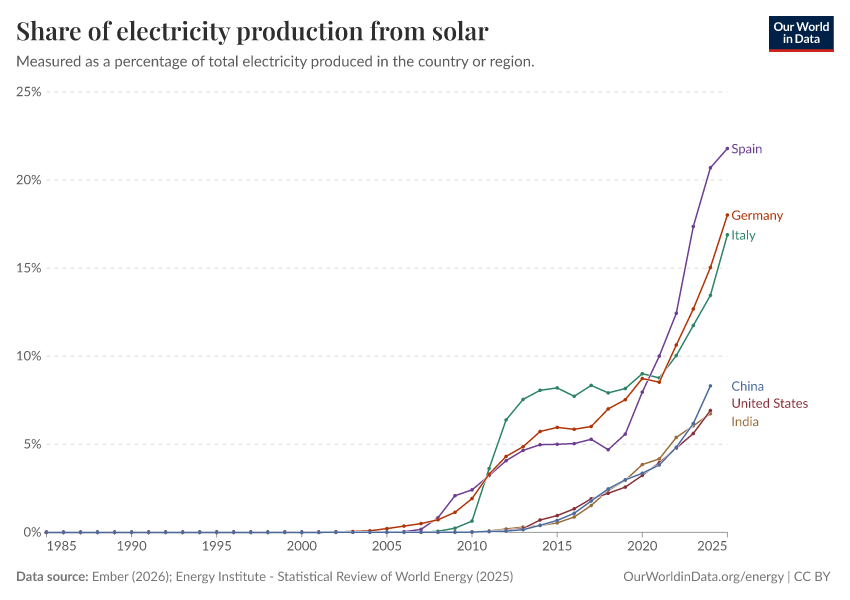
Share of electricity from solar by country. Source: Our World in Data, CC BY 4.0
Article by Jaroslav Holub · Edited by the Rejobs Editorial Team


Related specialisations
Renewable energy blog posts
-

Renewable Energy Forecast for 2030
By 2030, renewables are poised to supply nearly half of global electricity, with solar and wind leading this explosive expansion. In this data-driven piece, we explore job creation forecasts, supply chain bottlenecks, and policy hurdles. -

Fastest Growing Renewable Energy Sector: Data and Trends
In 2023, solar photovoltaics surged by 32.59%, officially making it the fastest-growing renewable energy source worldwide. Yet offshore wind, which soared by 57.87% in 2021, remains a formidable competitor in total electricity output due to its high capacity factor. This concise overview highlights how policy incentives, cost reductions, and manufacturing advances are propelling solar to the forefront of the global energy transition. -
Career Opportunities in Solar Energy
The solar energy sector is experiencing unprecedented growth, with over 7.1 million jobs in solar PV alone as of 2023. For professionals considering a career shift into renewable energy, solar offers pathways across R&D, manufacturing, project development, and operations.

