

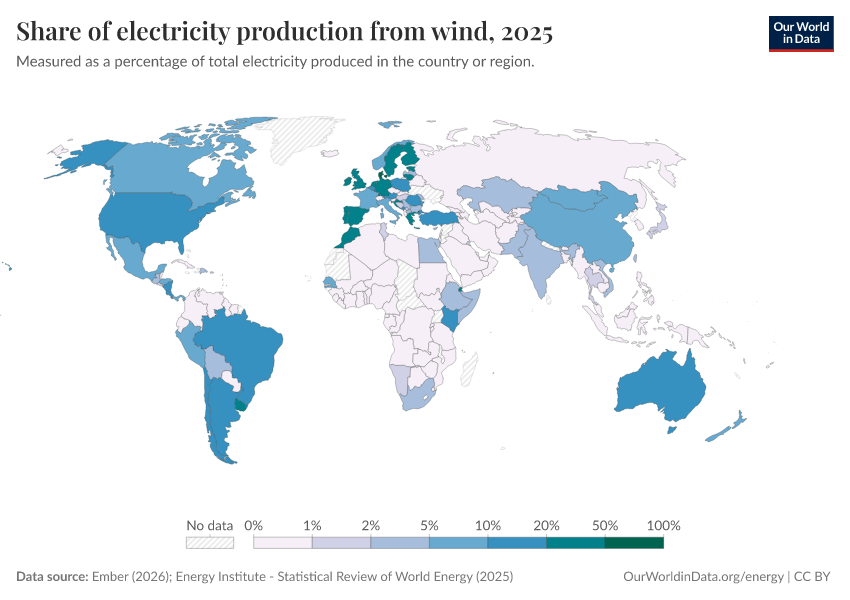
Wind energy employed 1.9 million people worldwide in 2024 - the fourth-largest employer among renewable energy sectors. Converting the kinetic energy of moving air into electricity takes turbines on towers up to 150 metres tall, and the jobs sit wherever those towers go up. Europe accounts for 442,800 of them and needs to reach 607,000 by 2030 to deliver the capacity its grids are already counting on. China holds roughly 61% of the global wind workforce - about 1.16 million people - and added 120.5 GW of new capacity in 2025, the first single-market 100 GW year in history. Global installed capacity reached nearly 1.3 TW at the end of 2025 after a record 165 GW added in a single year.
The headline numbers and the news cycle no longer point in the same direction. Ørsted cancelled the 2.4 GW Hornsea 4 project in May 2025 despite holding a Contract for Difference, took a write-down of up to DKK 4.5 billion, and in October 2025 announced it would cut 2,000 jobs - roughly 25% of the workforce - by 2027. The Trump administration suspended federal offshore wind permitting on its first day and tried to halt projects already under construction; a Massachusetts federal court vacated the order in December 2025 but the chilling effect on US investment is intact. Yet five weeks later the UK awarded a record 8.4 GW in AR7, the largest offshore auction in European history. Both stories are true at the same time, and they explain why the wind labour market in 2026 is dense with opportunity in some segments and contracting in others.
Offshore wind in 2024-2026
The cancellation of Hornsea 4 is the single most-cited datapoint in offshore wind right now, and the reasons matter for anyone weighing a career in the sector. Ørsted held a 15-year CfD at a strike price (the guaranteed £/MWh) set in 2024, but supply-chain inflation, vessel scarcity, and higher financing costs had pushed expected returns below the company's investment threshold. The price certainty of a CfD was not enough; turbine, monopile, cable, and installation-vessel costs all kept moving. The company kept the seabed rights and grid connection agreement, signalling that a future version of the project remains possible, but the project as auctioned is dead.
The Ørsted restructuring is the human consequence. The company will shrink from roughly 8,000 to 6,000 employees by 2027, narrowing geographically to Europe and selected Asia-Pacific markets and reducing its US footprint sharply. The first 500 redundancies were confirmed for Q4 2025, including 235 in Denmark. Equinor cut renewables investment by half over two years. Shell reduced its low-carbon workforce by 15% in 2024. The pattern is consistent: developers that overcommitted to US offshore in 2021-2023 are now retreating to European and Asian portfolios where the underlying economics still close.
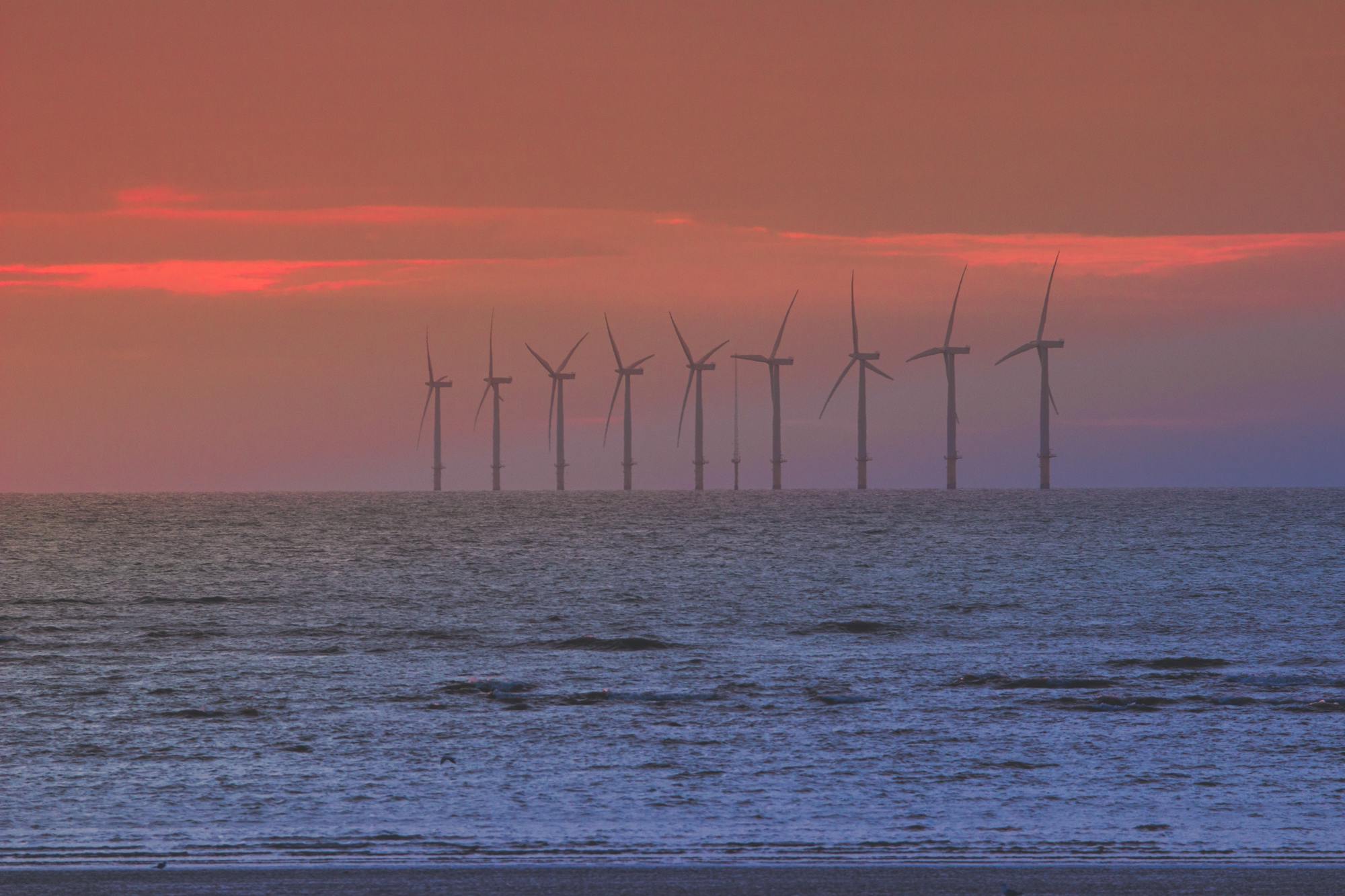
AR7 sits on the other side of the ledger. The UK awarded 8.4 GW across six fixed-bottom and two floating projects in January 2026 at strike prices of £91.20/MWh in England and Wales and £89.49/MWh in Scotland. RWE alone secured 6.9 GW including Norfolk Vanguard East and West, Dogger Bank South East and South West, and Awel y Môr; SSE took 1.4 GW for Berwick Bank Phase B. Floating wind cleared at £216.49/MWh for the 100 MW Erebus in the Celtic Sea and the 92.5 MW Pentland in Scotland. Round 5 of the Celtic Sea leasing process, meanwhile, has already directed 4.5 GW of floating capacity to Equinor, Gwynt Glas (EDF Renewables and ESB), and Ocean Winds. The pipeline is intact; the schedule has shifted.
The Netherlands tells a smaller, sharper version of the same story. The 2 GW IJmuiden Ver Alpha plot went to a Noordzeker consortium (SSE Renewables with Dutch pension funds ABP and APG) and the 2 GW Beta plot to Vattenfall and Copenhagen Infrastructure Partners' Zeevonk II joint venture, which includes an electrolyser at the Port of Rotterdam. But on 16 May 2025 The Hague postponed two of three planned 2025 offshore tenders over concerns there would be insufficient credible bidders. IJmuiden Ver Gamma-A, with EUR 4.76 billion in subsidy support, is slated for November 2026. Demand for a project of this scale has thinned. The same is true elsewhere in northern Europe.
Onshore wind in 2025
Strip out the offshore headlines and Europe had a record onshore year. WindEurope counted 19.1 GW of new wind capacity installed in 2025 across the continent, taking the total to 304 GW - 265 GW onshore, 39 GW offshore. 90% of the new build was onshore. Germany alone added 5.7 GW, 5.2 GW of it on land. Turkey added 2.1 GW and Sweden 1.8 GW, both entirely onshore. Spain grew its onshore installations by a third year-on-year. Offshore added just 2 GW to the grid in 2025; the consented backlog - projects with planning approval in hand - is larger than that for any individual market, but consented is not constructed.
For the labour market this matters in two specific ways. First, the onshore-skewed deployment means the immediate demand sits in turbine technician and electrical-engineering roles for German, Spanish, Turkish, and Scandinavian projects, not in offshore installation crews. Second, WindEurope's workforce model projects 22 GW of EU installations per year through 2030 to hit the 343 GW continental target. Hitting that needs an additional 164,200 workers above today's 442,800. The acute shortages it identifies before 2030: 7,000 blade maintenance technicians, 6,500 field engineers, and 5,000 pre-assembly technicians. Eight of the ten hardest-to-fill profiles are vocational rather than university-educated roles.
The IEA's warning that energy-sector entrant numbers need to rise 40% just to stop the gap from widening applies most directly to onshore wind. GWEC and GWO together estimate the global wind workforce needs to reach 628,000 technicians by 2030 from roughly 475,000 today.
Repowering older turbines
Nearly four in ten of Europe's 90,000 onshore turbines - roughly 34,000 - had passed 15 years of age by 2020, and 14 GW had been running for more than 20 years by end-2022. Replacing an early-2000s 1.5 MW machine with a current 6 MW turbine on the same foundation - a process the industry calls repowering - reduces unit count on average by 27% while tripling output. The repowered base worldwide is projected to grow from just over 21 GW in 2023 to 134 GW by 2033; WindEurope expects 16 GW of European repowering by 2030. Germany alone has a backlog of several hundred sites eligible under the federal repowering framework introduced in 2023.
The work profile sits closer to new-build than to maintenance: foundation surveys, grid-connection upgrades, planning consultation, mechanical commissioning, plus the decommissioning of the old machine. For technicians the practical implication is that repowering campaigns create concentrated, project-style hiring in regions that hosted the first European deployment boom - Schleswig-Holstein, Lower Saxony, Galicia, Castilla y León, North Rhine-Westphalia, southern Sweden. The blade-recycling segment around these projects is also growing fast as composite waste reaches volumes the sector did not have to handle when the fleet was being built.
Europe
European wind employment maps directly to turbine inventory, and the geographic distribution has tightened rather than spread out over the past three years.
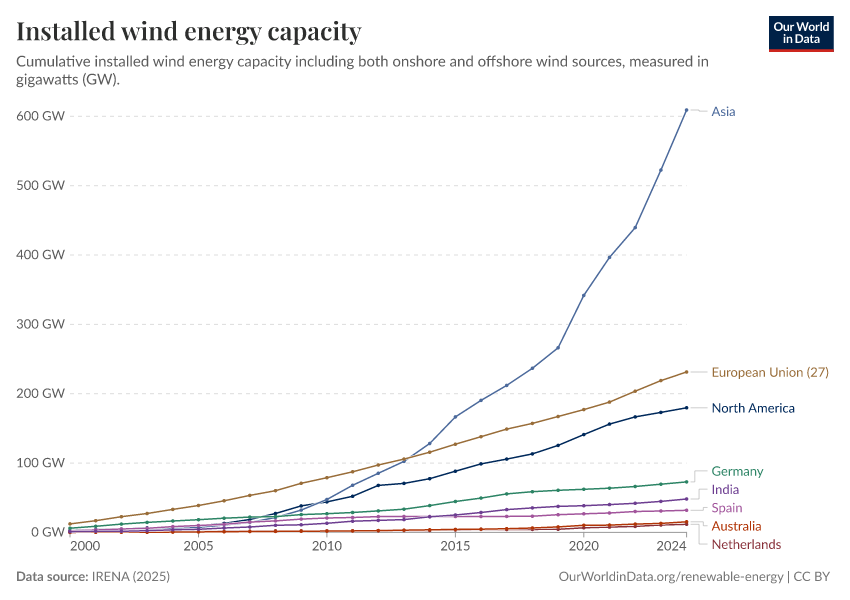
Germany is Europe's largest employer with an estimated 110,000 jobs against 72.7 GW of installed capacity. The 2025 expansion year took total capacity to nearly 78 GW. Onshore work concentrates in Schleswig-Holstein, Lower Saxony, and Mecklenburg-Vorpommern. The North Sea ports of Cuxhaven and Bremerhaven anchor offshore manufacturing and installation: Siemens Gamesa's Cuxhaven nacelle plant employs over 1,400 people and is currently producing 14 MW units. Hamburg, Bremen, and Berlin hold the engineering offices.
Denmark generates 56% of its electricity from wind - the highest share of any country - and hosts the global headquarters of Vestas (now 37,000 employees) and Ørsted, the world's largest offshore wind developer. Over 33,000 people work in the Danish wind sector. R&D, blade testing, and senior engineering concentrate around Aarhus and the Vestas blade campus at Nakskov. The Esbjerg port complex remains the largest offshore-wind logistics hub in Europe, handling shipments to North Sea projects from Hornsea to Borssele.
The United Kingdom holds 16 GW of offshore capacity and almost as much onshore. The sector employed 55,000 people at the last RenewableUK count, with offshore wind alone projected to need over 74,000 workers by 2030 - though RenewableUK's own analysis warns of a shortfall of nearly 38,000 workers across the wind industry by 2030 even if recruitment runs at current intent. Dogger Bank A (the first phase of the 3.6 GW Dogger Bank wind farm) generated first power in October 2023, and the AR7 awards have committed RWE and SSE to delivery timelines that intensify hiring through 2028-2030. The clusters: Aberdeen and Edinburgh for development and operations, Hull and Grimsby for blades and O&M (Siemens Gamesa Hull, Hornsea's East Coast Hub), Glasgow and Inverness for floating wind. ScotWind's earlier 25 GW seabed leasing round, by contrast, has slipped into a slow consenting phase that mirrors the US offshore reset more closely than the AR7 result.
The Netherlands holds 4.7 GW of offshore and targets approximately 21 GW by the early 2030s. Rotterdam and Amsterdam serve as logistics, manufacturing, and electrolyser-integration hubs for the entire European supply chain.
Spain grew its 2025 onshore installations by a third and holds over 33 GW of cumulative capacity, almost entirely onshore wind energy. Siemens Gamesa (around 30,000 employees) is headquartered in Zamudio in the Basque Country, and Iberdrola runs its global wind portfolio out of Bilbao.
China
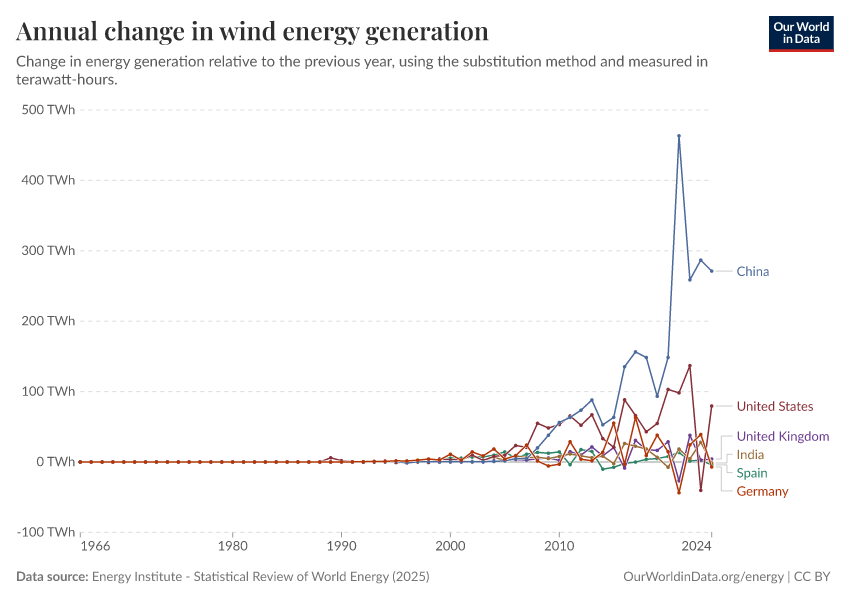
China is no longer just the largest wind market - it is the centre of gravity for the global industry. The country added 120.5 GW of new capacity in 2025 - more than the rest of the world combined in any single year before 2024 - and Chinese OEMs took 78% of global wind additions across 2025. Eight of the top ten manufacturer positions belong to Chinese firms: Goldwind installed 29.3 GW, Envision 20.9 GW, Mingyang 18.6 GW, with Windey, Sany, Dongfang, Shanghai Electric, and CRRC Wind Power filling out the list. The Chinese share is structural rather than cyclical, and the workforce numbers reflect that. IRENA puts China at roughly 1.16 million wind jobs, about 61% of the global total, split heavily toward manufacturing rather than installation.
The production geography is concentrated in four clusters. Goldwind is headquartered in Beijing with its principal turbine manufacturing in Urumqi and Yancheng, employing roughly 11,000 people across R&D, blade production, and assembly. Envision Energy runs its main operations from Shanghai with manufacturing campuses across Jiangsu and Inner Mongolia, employs around 7,000 people in its wind division, and has the most aggressive international expansion programme of the Chinese OEMs. Mingyang Smart Energy is anchored in Zhongshan in Guangdong and operates the country's largest offshore-turbine assembly line at Shanwei; its MySE 16-260 and MySE 18.X platforms have set successive industry records for rotor diameter. Sinovel retains a legacy service workforce in Liaoning, while Dongfang Electric re-entered the global top six in 2025 with around 13.5 GW installed from its Sichuan base. Component supply is similarly concentrated: the LM Wind Power blade plants in Tianjin and Qinhuangdao run under GE Vernova, CRRC's wind subsidiary in Yongji produces gearboxes and generators, and Goldwind's own subsidiaries handle most of the OEM's component pipeline.
For English-language readers, the career implication has flipped over the past three years. Chinese OEMs are now hiring abroad to win the next generation of European, MENA, and Latin American offshore tenders. Mingyang has run a sales-and-service base in Hamburg since 2020 and delivered its first European offshore order at Italy's Beleolico project; Envision Energy already operates engineering and after-sales offices in Silkeborg, Houston, Madrid, and London; Goldwind runs its European operations from Neunkirchen in Germany, with a UK office in Bristol. The roles being recruited - project managers, grid-code engineers, installation supervisors, country managers, multilingual after-sales - target candidates with European utility or western-OEM backgrounds. Anyone planning a long technical career in wind should expect to either compete against Chinese turbines on price and lead-time or, increasingly, to work for a Chinese employer's European subsidiary.
United States
The US is the second-largest wind market by installed capacity and home to roughly 130,000 wind jobs across manufacturing, installation, and operations, on IRENA's count. Onshore deployment runs at around 4-8 GW annually, a swing wide enough that crew demand moves with it, with Texas, Iowa, Oklahoma, and Kansas absorbing the bulk of the construction crews. Texas leads with over 40 GW of installed capacity. Iowa is the second-largest US wind producer and the country's most wind-dependent grid, with nearly 63% of in-state generation from wind. GE Vernova's Pensacola nacelle plant in Florida remains the largest US-flagged onshore turbine factory, supported by a tower-fabrication cluster in Iowa and supplier networks across the Texas Panhandle.
Offshore is the opposite story. The Trump administration's January 2025 pause on federal offshore wind permitting froze a pipeline that had already been struggling with margin compression. Vineyard Wind 1 completed turbine installation in early 2026 at 806 MW, Revolution Wind off Rhode Island delivered first power in early 2026, and Dominion Energy's 2.6 GW Coastal Virginia Offshore Wind project continued construction on the strength of its self-build model that bypasses federal financing arrangements. But the consented backlog at New York Bight, Central Atlantic, and Gulf of Maine lease sites is moving slowly enough that GE Vernova has scaled its offshore exposure down to two committed projects, and Siemens Gamesa has paused most of its US offshore investment plans. The practical implication for jobseekers: Texas and Iowa O&M roles continue to advertise at a stable pace, the southeast manufacturing belt around Pensacola and Mobile is hiring for onshore production, but offshore-installation hiring in the northeast looks choppy at best until federal permitting resumes. The ScotWind slow-down in the UK is the closest comparator for the trajectory of US offshore over the next two years.
India and Asia-Pacific
India added 3.42 GW of new wind in 2024, its strongest year since 2017, with Suzlon Energy leading the domestic order book at over 6 GW of confirmed contracts on the back of a financial turnaround that took the company out of debt restructuring in 2024. Adani New Industries and Inox Wind are scaling fabrication around Mundra and Una respectively, and the Production-Linked Incentive scheme is now drawing component suppliers (blade, gearbox, generator) into Gujarat and Tamil Nadu. The workforce is concentrated around Pune, Ahmedabad, Chennai, and the Tirunelveli wind belt, and Suzlon alone employs roughly 8,000 people in India.
Roles along the value chain
The work breaks into five clusters, of which the largest and fastest-growing is operations and maintenance.
Project development and finance
Project developers identify sites, run feasibility studies, negotiate land leases, secure permits, arrange grid integration, and structure financing. A single offshore project carries investment over EUR 1 billion and permitting timelines of 5-10 years; the Hornsea 4 cancellation is a reminder that those timelines are precisely what make the role hard. European developers typically earn EUR 60,000-90,000 with senior roles exceeding six figures.
Wind resource assessment specialists use LiDAR, SODAR, and meteorological mast data to model site yield, often combined with remote sensing and weather forecasting models. Office-based, analytical work with a foundation in atmospheric science, physics, or mathematics.
Project finance specialists build financial models, structure debt and equity, negotiate offtake contracts and corporate PPAs. The collapse of bankable margins on US offshore projects has shifted the locus of dealmaking back to European utilities and pension funds; the IJmuiden Ver and Celtic Sea awards both involved consortia structured around pension capital.
Manufacturing and supply chain
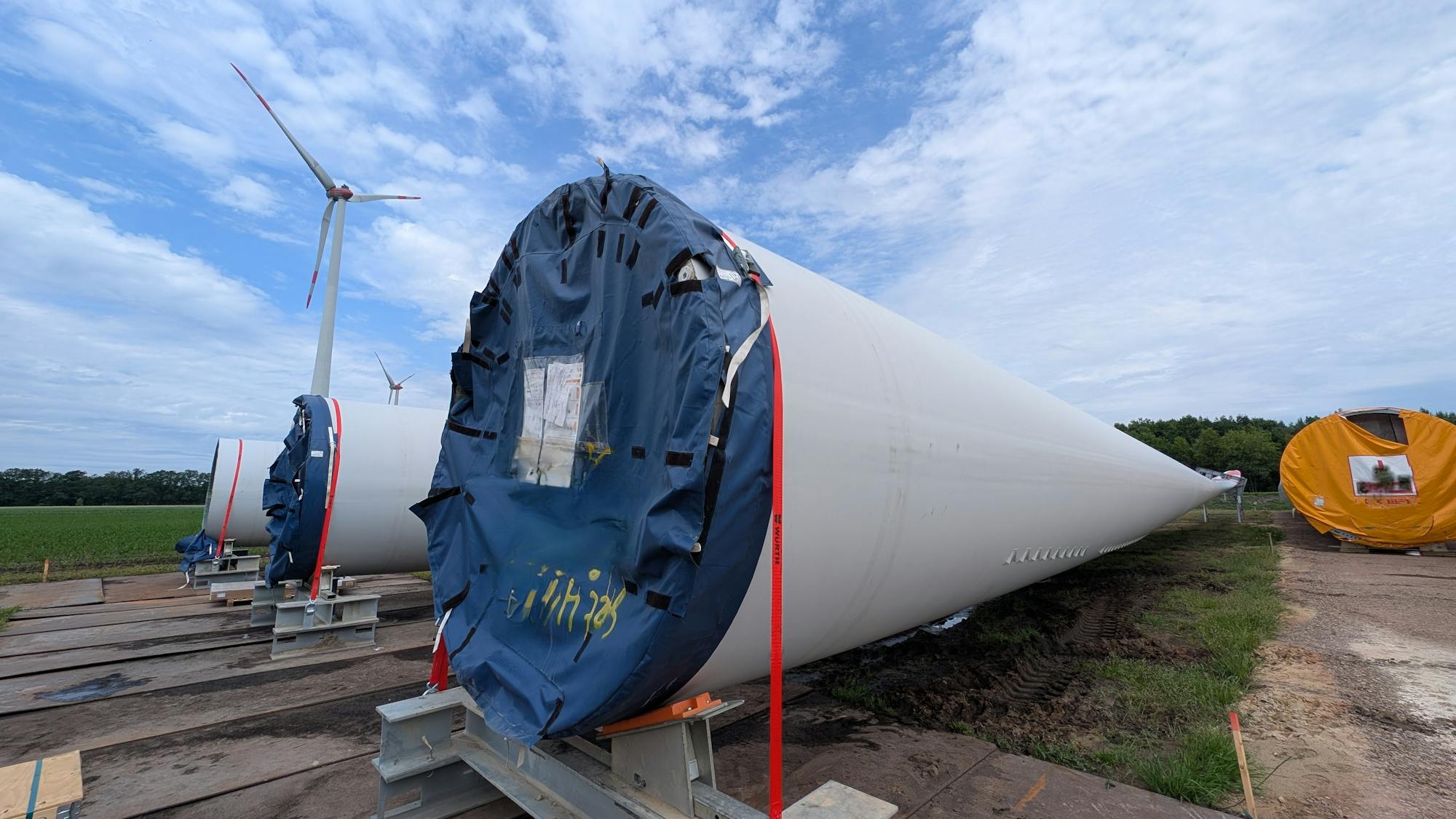
Over 250 factories across Europe produce turbine components and grid equipment; manufacturing accounts for nearly half of all direct wind jobs in Europe. The largest concentrations are in Denmark (Nakskov, Aarhus, Esbjerg), Germany (Cuxhaven, Bremerhaven, Magdeburg), and Spain (Reinosa, Zamudio, Asteasu). Polish blade fabrication is expanding fast around Goleniów and Szczecin. Outside Europe, China's Tianjin, Yangjiang, and Yancheng clusters and India's Pune and Chennai supplier belt are the largest production centres globally.
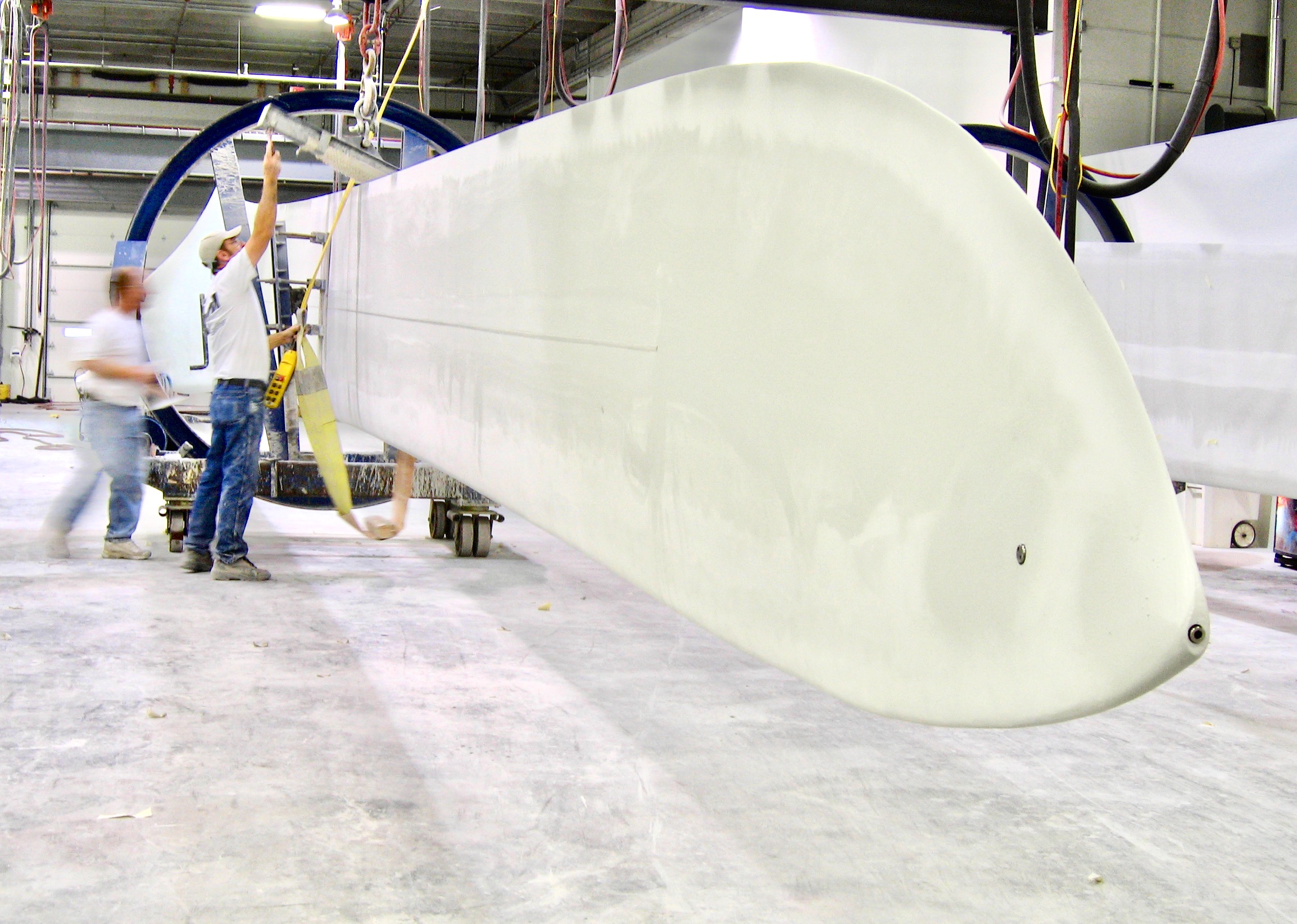
Production technicians assemble nacelles, blades, and towers. Blade work is the most specialised - fibreglass and carbon-fibre composites on components exceeding 100 metres. Supply-chain specialists coordinate the movement of oversized components by road, rail, and barge, plus increasingly the offshore vessel coordination that the cancellation of Hornsea 4 brought into focus.
Construction and installation
Wind turbine technicians are the largest single occupation and the principal bottleneck. They assemble tower sections, nacelles, and rotors using heavy cranes, then perform electrical and mechanical commissioning - work that happens at 80 to 150 metres in variable weather. Tower climbing is a daily reality. The training pipeline takes 12-18 months in formal programmes plus several years of field experience to reach independent fault-finding competence.
Site managers coordinate dozens of workers, run schedules, enforce safety, and liaise with landowners and grid operators. They hold budget responsibility for projects often in the hundreds of millions of euros.
Offshore engineers handle the specifics of marine installation: foundation design (monopile, jacket, floating), subsea cable routing, vessel coordination, coastal engineering. The highest-paid technical category in the industry. The EPC management layer that integrates these workstreams has become a specialism in its own right as project complexity has scaled.
Operations and maintenance
With nearly 1.3 TW installed globally, wind O&M is the fastest-growing employment segment in the sector and was the only segment where workforce demand actually accelerated in 2025. The global wind O&M market was estimated at USD 39.6 billion in 2025 and is projected to reach USD 59.7 billion by 2030.
Service technicians carry out scheduled inspections, oil changes, electrical-system checks, and unplanned repairs. Onshore technicians cover regional clusters; offshore technicians work two-on, two-off rotations, transferred to wind farms by crew transfer vessel or helicopter. The premium for offshore work runs at 20-40% over onshore equivalents. In the US, Iowa and Texas onshore O&M roles dominate the field and offer the most stable hiring pattern outside Europe and China.
Turbine operations specialists monitor hundreds of turbines from control rooms, identify anomalies in SCADA data, dispatch maintenance, and optimise performance curves. The role is increasingly analytical; SCADA engineers in Denmark earn between DKK 543,000 and 956,000 a year.
Asset managers run the financial and technical performance of wind-farm portfolios, deciding when to replace components, repower, or sell. A senior role combining engineering with portfolio strategy.
Engineering and digital
Electrical engineers design power electronics, transformer stations, and grid-connection systems. As wind farms hybridise with energy storage and smart grid infrastructure (a trend that the Zeevonk II IJmuiden Ver project crystallises by co-locating offshore wind with an electrolyser), this role expands in both volume and complexity.
Digital twin engineers and SCADA specialists build virtual models of turbines and full wind farms, using IoT sensor streams and machine learning to predict failures and optimise output. Digital-twin platforms can now flag component failures before they occur. These are among the best-paid roles in the sector.
Hybrid power plant specialists are emerging as a category in their own right as wind-plus-storage and wind-plus-hydrogen co-located projects move from pilot to commercial deployment.
Salary overview
Annual gross salary ranges for the four largest European wind labour markets in 2025-2026:
| Role | Germany | Denmark | United Kingdom | Spain |
|---|---|---|---|---|
| Wind turbine technician | EUR 42,000 - 72,500 | DKK 390,000 - 712,000 | GBP 27,000 - 47,000 | EUR 26,000 - 42,000 |
| Offshore technician | EUR 45,000 - 75,000 | DKK 420,000 - 620,000 | GBP 33,000 - 60,000 | EUR 32,000 - 50,000 |
| Wind energy engineer | EUR 55,000 - 85,000 | DKK 500,000 - 950,000 | GBP 35,000 - 55,000 | EUR 38,000 - 62,000 |
| Project manager | EUR 58,000 - 92,500 | DKK 460,000 - 960,000 | GBP 40,000 - 75,000 | EUR 45,000 - 78,000 |
| SCADA / control systems engineer | EUR 65,000 - 114,000 | DKK 543,000 - 956,000 | GBP 34,000 - 59,000 | EUR 42,000 - 70,000 |
| HSE manager (offshore) | EUR 68,000 - 116,000 | DKK 494,000 - 756,000 | GBP 50,000 - 80,000 | EUR 48,000 - 80,000 |
| Asset manager | EUR 65,000 - 110,000 | DKK 520,000 - 920,000 | GBP 48,000 - 95,000 | EUR 50,000 - 85,000 |
Annual gross ranges from 2025-2026 data: SalaryExpert, Glassdoor, ERI, and the Astute People Renewable Energy Salary Guide 2025. Offshore roles include premiums of 20-40% over onshore equivalents. Business development roles typically carry an additional 15-25% variable component not reflected here. DKK figures roughly compare at EUR 1 ≈ DKK 7.45.
UK renewables staff saw an average 13.2% salary rise in 2025, and renewable-energy salaries across Europe ran 40% above the global average as the skills shortage tightened. Specialised offshore roles in floating-wind installation and high-voltage cable engineering command the strongest premiums.
Working conditions
Height work is structural to the technician role. Modern nacelles sit 80 to 150 metres above ground, are cramped, vibrate, and carry generator and gearbox noise. Turbine manuals and site risk assessments stop elevated work at sustained wind speeds above roughly 18 m/s; DGUV and HSE guidance set similar limits. Falls, electrical contact, and rotating-equipment crush injuries are the principal safety risks. GWO Basic Safety Training is non-negotiable: a four- to five-day course covering first aid, manual handling, fire awareness, working at heights, and for offshore work sea survival. Certification runs two years and is logged in the WINDA database. Around 185,000 technicians held valid GWO certification at end-2024 and 122,008 received training in 2024 alone.
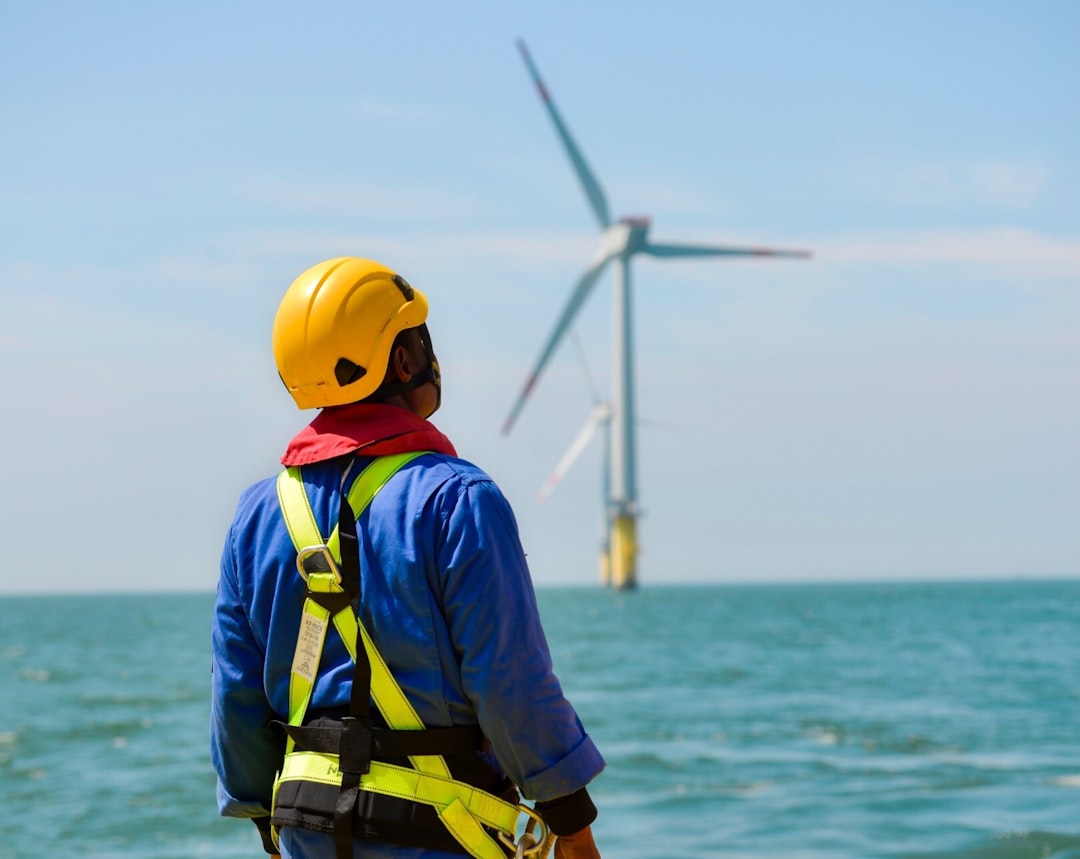
Offshore rotations restructure your life around the work. Two weeks on a service operation vessel or accommodation platform, two weeks off, 12-hour shifts, transfers by crew transfer vessel in moderate seas or helicopter in worse. Compensation is meaningfully higher than onshore, and so is the wear. For technicians in their twenties or with flexible domestic arrangements it is the fastest path from entry-level into senior offshore work. For others it is the reason they remain onshore.
Seasonality is less pronounced than in solar but real. Wind blows year-round, so service work runs continuously. But major maintenance is scheduled for summer (lower wind, lower lost revenue), and offshore construction in northern Europe concentrates in the April-October weather window. The 2025 rebalancing toward onshore deployment in Germany, Turkey, and Sweden has put less of the workforce through this seasonal compression than in the offshore-heavy 2022-2024 cycle.
Office roles increasingly offer hybrid arrangements. Project managers, energy analysts, design engineers, software developers, and commercial roles run on standard hybrid patterns. Vestas, Vattenfall, Ørsted, and Iberdrola advertise senior positions workable from multiple European cities.
The diversity profile remains uneven. Women make up 21% of the global wind workforce, below the 32% average across all renewables. In senior management the figure falls to 8%. Industry initiatives - GWEC's Women in Wind programme, employer-level targets at Ørsted, Iberdrola, and SSE - exist but the data has barely moved over the past five years.
Entry routes
Technician routes without a university degree
Wind turbine technician roles typically require an electrical, mechanical, or mechatronic trade qualification, physical fitness, comfort at heights, willingness to work outdoors in variable weather, and a driving licence for onshore work. The gateway certification is GWO Basic Safety Training plus increasingly GWO Basic Technical Training (BTT) - a four-module mechanical, electrical, hydraulic, and installation course that the major OEMs now treat as the floor for service work.
In Germany, the dual-system Ausbildung as Elektroniker für Betriebstechnik or Mechatroniker remains the standard entry route. The UK runs structured apprenticeships through RWE and several offshore developers, typically 2-4 years. Ireland runs a dedicated three-year wind turbine apprenticeship. For experienced electricians, accelerated programmes like the GWS Academy can qualify a candidate in as little as two weeks plus GWO certification. The German BZEE and Bremen-based WAB training networks are the most established cross-border feeders into the North Sea sector.
OEM-run training is increasingly the alternative path. Vestas trains its own technicians and apprentices in Denmark; Siemens Gamesa runs its Brande training centre; Nordex operates facilities in Hamburg and Słupsk. Most accept candidates with vocational electrical or mechanical qualifications and place them directly into service contracts on completion.
Engineering and specialist roles
Engineering positions require university qualifications in electrical, mechanical, structural, or energy engineering. Useful specialisations include aerodynamics and composites for blade design, power electronics and grid systems for electrical engineers, atmospheric science and physics for resource analysts, data science and software engineering for digital roles.
Europe offers over 150 Master's programmes in renewable energy. The joint European Wind Energy Master across TU Delft, DTU, NTNU, and the University of Oldenburg is the most respected, and the European Master in Renewable Energy with a core track at Oldenburg is the broader sibling track. For project management, PRINCE2 or PMP is the European preference; for offshore HSE, NEBOSH plus advanced GWO modules.
Transitioning from adjacent industries
Wind is the most accessible clean-energy sector for career changers, and the routes have hardened into standard practice.
Oil and gas is the most natural feeder industry. Robert Gordon University research estimates that over 90% of UK oil and gas workers hold skills moderately to highly transferable to wind. Offshore installation managers, HSE advisors, marine engineers, project managers, and high-voltage electricians move into equivalent wind roles with minimal retraining. Offshore Energies UK operates a formal skills transition roadmap linking the two sectors. Oil and gas still pays roughly 15% more for equivalent positions, though the gap has narrowed as wind salaries rose through 2024-2025.
Construction and trades. Electricians, welders, crane operators, and heavy-equipment operators carry directly applicable skills for wind-farm construction. GWO certification is usually the only additional requirement. Welding is particularly sought-after for floating-foundation fabrication, where steel-jacket fabrication backlogs at yards in Norway, Spain, and Poland are running 18-24 months long.
IT and software. The digitalisation of wind energy creates steady demand for developers, data scientists, and IoT specialists building SCADA platforms, predictive maintenance systems, performance analytics tools, and electricity-trading software. Prior energy-sector experience helps but is not required for software roles.
Automotive and aerospace. Composite-materials knowledge, aerodynamics, quality assurance, and precision-manufacturing experience transfer directly to blade production and turbine design. Germany's automotive sector has been a feeder industry for wind manufacturing for over a decade.
Key employers
The wind sector is anchored by turbine manufacturers, project developers, and specialist service companies, plus a layer of engineering consultancies that have grown sharply as offshore and floating-wind project pipelines have expanded.
Turbine manufacturers
- Vestas - Denmark, 37,000 employees, EUR 17.3bn 2024 revenue, EUR 68.4bn combined order backlog at end-2024
- Siemens Gamesa - Spain/Germany, around 30,000 employees, leads offshore turbine technology including the SG 14-236 DD
- Nordex - Germany, 10,400+ employees, onshore focus on European and Latin American markets
- Enercon - Germany, around 13,000 employees, gearless onshore turbines and the dominant German service provider for legacy fleets
- GE Vernova - US, Pensacola (Florida) nacelle plant anchors the onshore Cypress and Sierra platforms; offshore exposure narrowed sharply in 2025 to two contracted projects only
- Goldwind - China, around 11,000 employees, Beijing HQ with Urumqi and Yancheng manufacturing, 29.3 GW installed in 2025
- Envision Energy - China, around 7,000 employees, Shanghai HQ with Jiangsu and Inner Mongolia plants, 20.9 GW installed in 2025, broad international presence
- Mingyang Smart Energy - China, Guangdong-based, 18.6 GW installed in 2025, leading Chinese offshore export competitor with Europe service base in Hamburg
- Suzlon Energy - India, Pune HQ, around 8,000 employees, 6+ GW Indian order book after the 2024 financial turnaround
- Dongfang Electric - China, Sichuan-based top-six OEM with around 13.5 GW installed in 2025; Sinovel survives on its legacy fleet in Liaoning
Developers and operators
- Ørsted - Denmark, currently around 8,000 employees moving to 6,000 by 2027 under the restructuring; world's largest offshore developer
- RWE - Germany, 20,800+ employees in the wider energy business; the AR7 dominant winner with 6.9 GW awarded in January 2026
- Iberdrola - Spain, 45,000+ employees, leading European onshore operator and growing offshore portfolio
- Vattenfall - Sweden, partner in Zeevonk II at IJmuiden Ver and major onshore operator across the Nordics
- SSE Renewables - Scotland, around 1,900 renewable specialists, AR7 winner for Berwick Bank
- Equinor - Norway, scaled back renewables investment in 2024-2025 but remains a Celtic Sea Round 5 winner
- Ocean Winds - joint venture of EDP Renewables and Engie, Celtic Sea Round 5 award holder
- EDP Renováveis - Portugal, global onshore and offshore developer with growing North American and Asian portfolio
- Dominion Energy - US, self-build developer of the 2.6 GW Coastal Virginia Offshore Wind project
- Adani New Industries and Inox Wind - India, leading domestic developers behind the post-2024 deployment recovery
- EnBW, EDF Renewables, TotalEnergies, Statkraft round out the European developer field
- Polenergia - Poland, Equinor's partner on the 1.44 GW Bałtyk 2 and 3 projects
Independent service companies and engineering consultancies
- Deutsche Windtechnik - Germany, around 2,700 employees servicing more than 10 GW across 7,900 turbines on multi-brand contracts
- Global Wind Service - Denmark, international service organisation hiring out of every major European market
- DNV and Ramboll - Norway and Denmark, engineering consultancies with thousands of staff in wind-related project work
- Seaway7 and Sif Group - offshore installation specialists and monopile fabrication respectively
Outlook to 2030
The arithmetic for European wind through 2030 splits into two timelines moving at different speeds. Onshore is in its strongest deployment cycle since the early 2010s: WindEurope projects 22 GW of EU installations per year through 2030, driven by Germany's 5+ GW annual run-rate, Spain's renewed auction discipline, and faster permitting under the Renewable Energy Directive III. Offshore deployment in 2025 added just 2 GW to the grid, but the consented and contracted pipeline is genuinely large - AR7's 8.4 GW, Celtic Sea Round 5's 4.5 GW, IJmuiden Ver's 4 GW, Hesselø and Energy Island in Denmark, and the German North Sea expansion - and most of it lands in the workforce between 2027 and 2030. The Hornsea 4 cancellation is the warning that even contracted projects can fall away when supply-chain costs run hot enough; the AR7 result is the signal that price-discovery has adjusted.
The numbers worth holding in mind. WindEurope needs the European wind workforce to grow from 442,800 to 607,000 by 2030 - an additional 164,200 workers - to deliver the capacity already in national plans. RenewableUK projects an almost 38,000-person shortfall in the UK wind workforce alone by 2030 even on conservative assumptions. The US workforce of roughly 130,000 will continue to grow on the onshore side and stall on offshore until federal permitting resumes. China will continue to dominate global volume and supply: 120.5 GW added in a single year is already more than six times Europe's full-continent throughput, the country's 1.16-million-strong workforce sits across a manufacturing base that supplies most of the world's new turbines, and the European subsidiaries of Goldwind, Envision, and Mingyang are likely to be among the most active wind recruiters in the EU over the next five years.

.jpg)